
Over-door pantry organisers: a fit-first guide for Australian kitchens
An over-door pantry organiser can make small packets and everyday ingredients easier to reach, but only if its hooks fit the door and its baskets clear the shelves. Measure the door thickness, top gap and space behind the closed door before choosing a rack.
Research-based guide with product photographs, published specifications and practical fit checks. No hands-on testing or universal door compatibility is claimed.
Is a door rack right for your pantry?
Choose one when the door has unused space behind it and the things you want to store are awkward on a shelf. Sachets, small snack packets and lighter everyday items are sensible starting points. A door rack is less useful when shelves run almost to the door or the door already catches on its frame.
More baskets do not automatically mean more usable storage. You still need room to lift items out, close the door and reach the upper tiers. A shorter rack can be easier to live with than a full-height unit filled with things you rarely use.
Measure the door before the organiser.
Door thickness
Measure the door slab where the hook will sit. Compare it with the hook’s internal opening or the manufacturer’s specified door thickness. Do not assume a hook described as standard fits every Australian cupboard door.
Gap above the door
The hook material must pass between the door and its frame without binding. This gap is separate from the hook opening. If the supplier does not publish the hook thickness, ask before ordering.
Space behind the door
Measure from the inside face of the closed door to the nearest shelf edge, container or other obstruction at each planned basket height. Use the smallest relevant distance.
Clear width and height
Map handles, raised panels, hinges and locks. Leave room to reach into the top basket and keep the bottom of the rack clear of the floor or cupboard base.
The door’s swing
A basket can clear the shelves when closed but hit a side wall while opening. Use a cardboard template to represent the rack’s width and projection, then move the door slowly through its usual travel.
Ask for missing dimensions
If a listing gives basket depth but not the distance from the door to the outermost point of the assembled rack, request that measurement. Include brackets, spacers and any items that stick out.
Conceptual side view, not to scale. A closed-door depth measurement does not test the opening arc or top hook.
Two hanging racks, plus a modular option
These examples show the differences between a ready-made rack and a component system. They are not a tested ranking. Product photos are credited below; props shown with a rack may not be included.
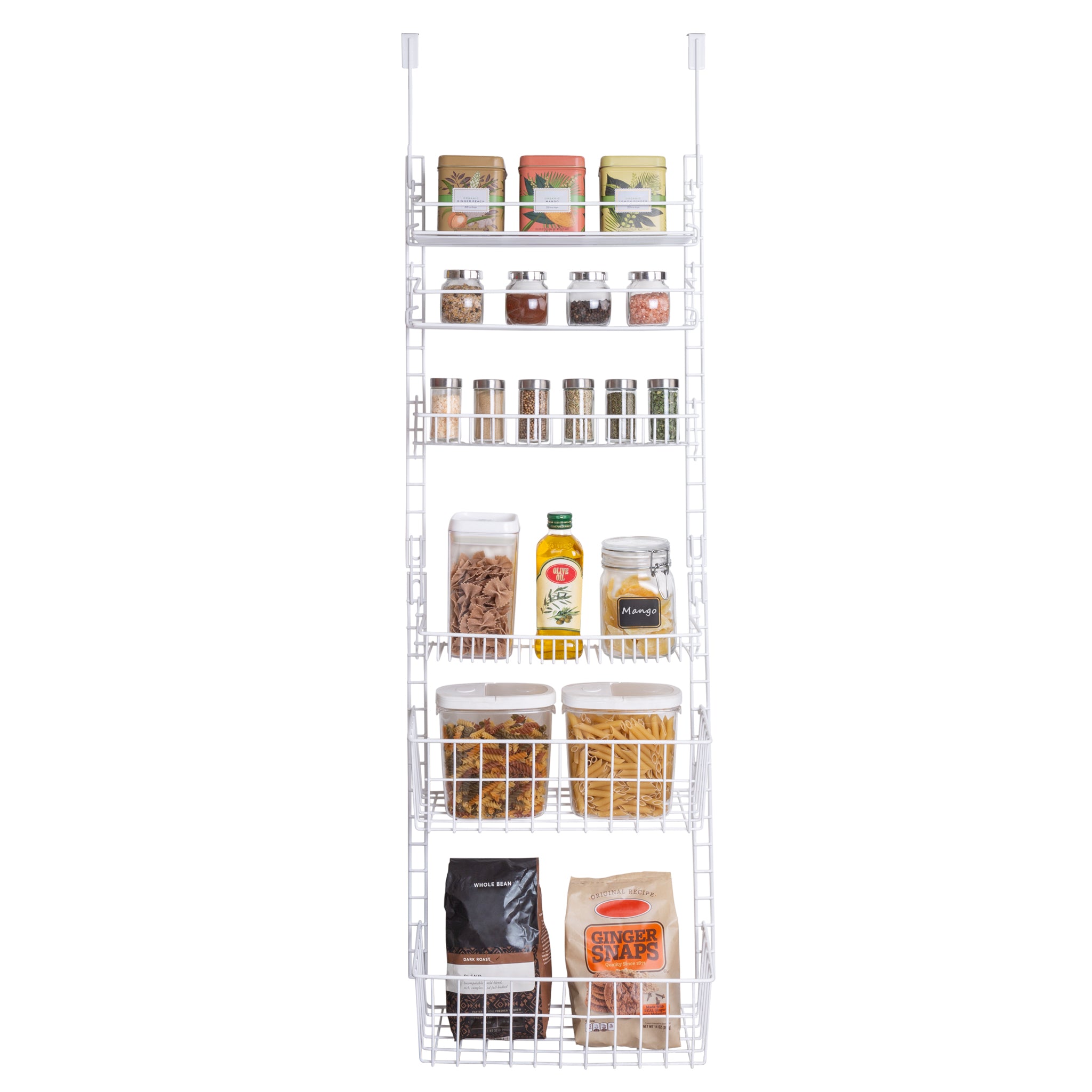
Smart Design six-tier wire pantry organiser
The manufacturer’s six-tier description lists adjustable baskets and an overall size of 17 × 7 × 61 inches, equivalent to about 43.2 cm wide, 17.8 cm deep and 154.9 cm high. It also lists over-door hooks and wall-mounting hardware.
The page combines five-tier, six-tier and shorter variants. Match the selected variant to its own dimensions; do not apply the six-tier measurements to every option. The international specification is useful for comparison, but Australian delivery and the hook fit still need checking.
Read the supplier specification. Amazon search results may include different sizes or alternatives.
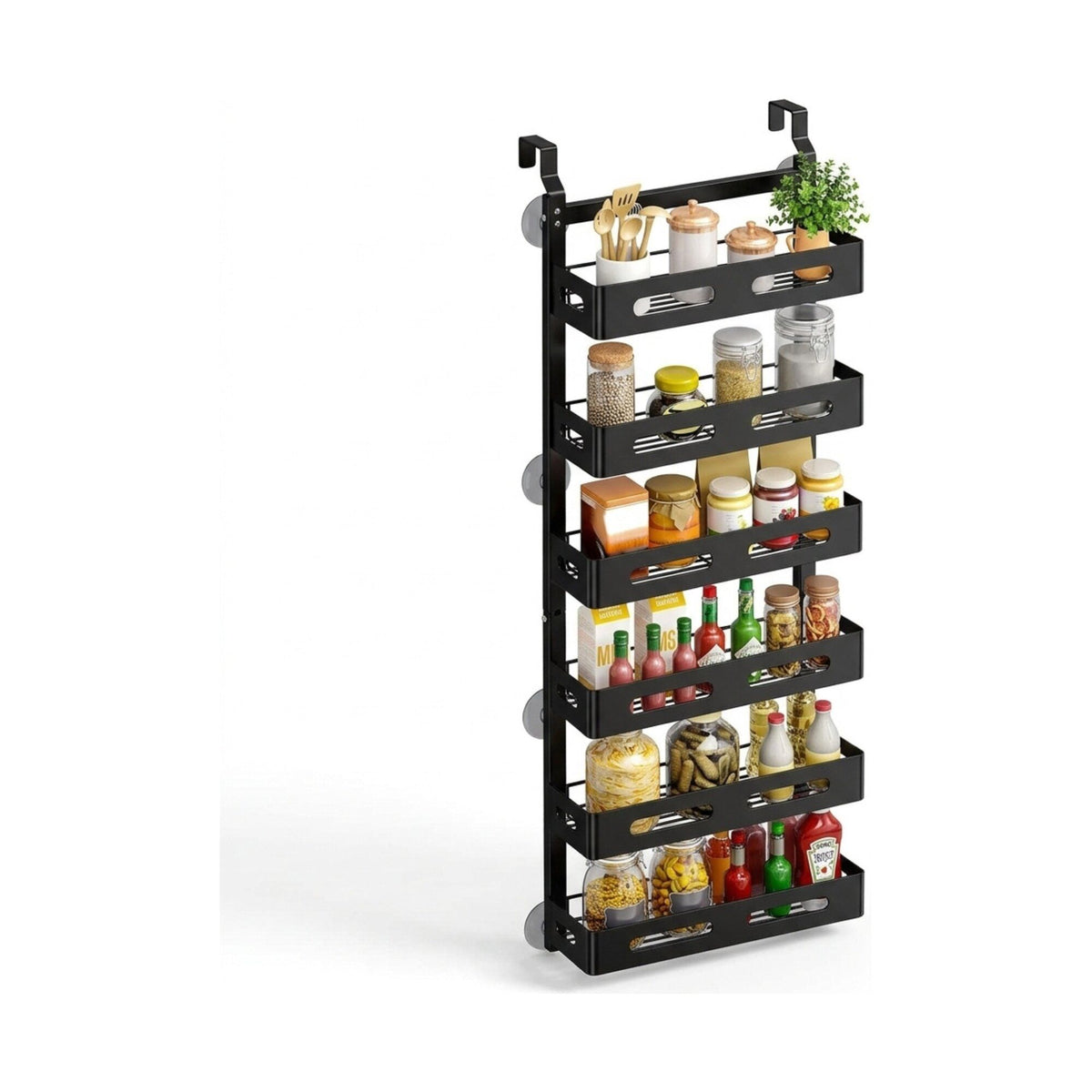
CARLA HOME six-tier over-door pantry organiser
CARLA HOME describes adjustable baskets, over-door hooks and suction-cup stabilisers. Its product description gives overall dimensions of 42 × 18 × 131 cm.
However, the same page labels width and depth differently in its specification fields. Confirm which measurement is the assembled projection from the door. Do not choose it for a tight gap using the labels alone.
Read the supplier specification. Amazon search results may include different sizes or alternatives.
Elfa: check the components, not just the baskets
Elfa’s Australian page for hook set 330410 specifies a 40 mm thick door, a door height of 2010–2150 mm and a 1980 mm wallband. The hooks alone are not a complete pantry rack. Compatible baskets and the rest of the system need to be selected separately.
This is a useful example of why exact door measurements matter. Ask the retailer to check the complete configuration and its load guidance. Read Elfa’s hook specification.
Basket-clearance checker
Enter the distance from the closed door’s inside face to the nearest obstruction. Then enter the assembled rack’s projection from the door, including brackets and anything that protrudes.
The buffer is extra space you choose to reserve. The example uses 1 cm to show the calculation; it is not a manufacturer’s recommended clearance or a safety standard.
Formula: remaining clearance = door-to-obstruction distance − rack projection − chosen buffer. This does not test hook fit, width, height, the opening arc or the door’s ability to carry a load.
Over-door, fixed to the door or fixed to the wall?
| Mounting type | Why consider it | What to confirm |
|---|---|---|
| Hanging over-door rack | Can avoid drilling when installed exactly as intended. | Hook opening, top clearance, stabilisers, load rating and door movement. |
| Rack screwed to a door | May avoid the need for a hook over the top. | Door construction, approved fixing locations, screw depth and permission where relevant. |
| Wall-mounted organiser | Moves storage away from the door and its hinges. | Wall type, suitable fixings and the space needed to reach each basket. |
| Modular door system | Lets you select compatible basket sizes and positions. | Every required component, door compatibility and the complete system’s load guidance. |
A no-drill label does not mean no marks or no movement. Hooks can rub against paint if they do not fit, and adhesive pads may affect some finishes. Use only the padding and stabilisers permitted by the maker. Adding a thick pad can change the fit of the hook.
If the door is hollow-core, has a damaged top edge or has loose hinges, do not assume a hanging rack or screws will be suitable. Ask the rack supplier or an installer to assess the door. Never use screws longer than the door construction allows, and do not modify a fire door or its clearances to make an organiser fit.
A practical installation check
Read the exact instructions
Check the model number, parts and assembly order. Confirm whether suction cups, straps, adhesive pads or bottom brackets are required. Do not leave out a stabiliser because the empty rack seems steady.
Test the empty rack
Close and open the door slowly without forcing it. Watch the hooks, latch, shelf edges and adjacent wall. If it binds or scrapes, remove it and resolve the fit problem before adding food.
Add a small load
Follow the maker’s total and per-basket limits. Begin with light packets. Check again for movement, rubbing and changes in the way the door closes. A basket rating does not establish the load capacity of your door.
What belongs in the baskets?
Start with the items you use often and can lift easily: sealed sachets, small packets or other light pantry goods. Match basket spacing to the actual packaging. Tall bottles need room to be lifted out, and short sachets can disappear in deep baskets.
Keep heavier items on suitable fixed shelving unless the rack and door arrangement are explicitly rated for them. Avoid putting breakable jars where an ordinary door movement could tip them out. Keep loose packaging and straps away from the latch and hinges.
Follow the original food labels when deciding what can stay in the pantry. A door basket does not change refrigeration instructions or date marks. NSW Food Authority recommends following storage directions and rotating stock so older items are used first. Read its food storage advice.
Your door-rack checklist
Tick these as you measure and confirm the listing. The checklist stays in this page session and does not send your measurements anywhere.
0 of 6 checks completed.
When a shelf organiser is the better choice
If the door gap is tight, the hooks are a poor match or the rack would block the shelves, keep the storage on a fixed shelf. A handled bin can bring packets forward, a riser can make the back row visible and a turntable can help with bottles.
Our pantry organiser comparison for Australia covers those alternatives with dimensions and product photos. You can also start with the Shelf & Pantry home guide if you are still deciding which part of the kitchen to organise first.
Over-door pantry organiser FAQs
Do over-door pantry organisers fit all Australian doors?
No. Door thickness, top clearance and the space behind the door vary. Match the hook to the door and check the complete assembled rack. A listing that says standard door is not a substitute for measurements.
Will an over-door organiser stop my pantry door closing?
It can if the hook binds against the frame or a basket contacts a shelf. Check both areas, then test the whole opening and closing movement with the empty rack. Do not force the door shut.
Can I use an over-door pantry organiser in a rental?
Possibly, if the fit and installation method suit the property. Check your rental requirements before attaching adhesive pads or fixings. No-drill products can still rub or mark a finish, so do not assume they are automatically damage-free.
How much weight can a pantry door rack hold?
Use the limits for the exact rack and each basket, and confirm the door is suitable for that load. There is no universal weight allowance. If the listing does not state a limit, ask the supplier rather than estimating from the number of baskets.
Are six-tier racks better than four-tier racks?
Only when the extra tiers are reachable and clear the shelves. Compare total height, basket spacing and the items you plan to store. A shorter rack may fit the useful part of the door more comfortably.
What if the width and depth in a listing conflict?
Ask the supplier for an assembled dimension diagram. In particular, confirm the distance from the door face to the outermost part of the rack. Do not use an ambiguous measurement to approve a tight fit.
Sources and product details
Product observations are based on supplier information, not hands-on testing. Missing or conflicting fit information is identified in the guide.
- Smart Design: wire pantry organiser and variant specifications
- CARLA HOME: six-tier organiser
- Elfa Australia: over-door hook 330410
- NSW Food Authority: keeping food safe
Search results may include unrelated sizes and products. Confirm the selected listing before purchase.